
Asia/Shanghai
WorkMay 29, 2026

Production Release System

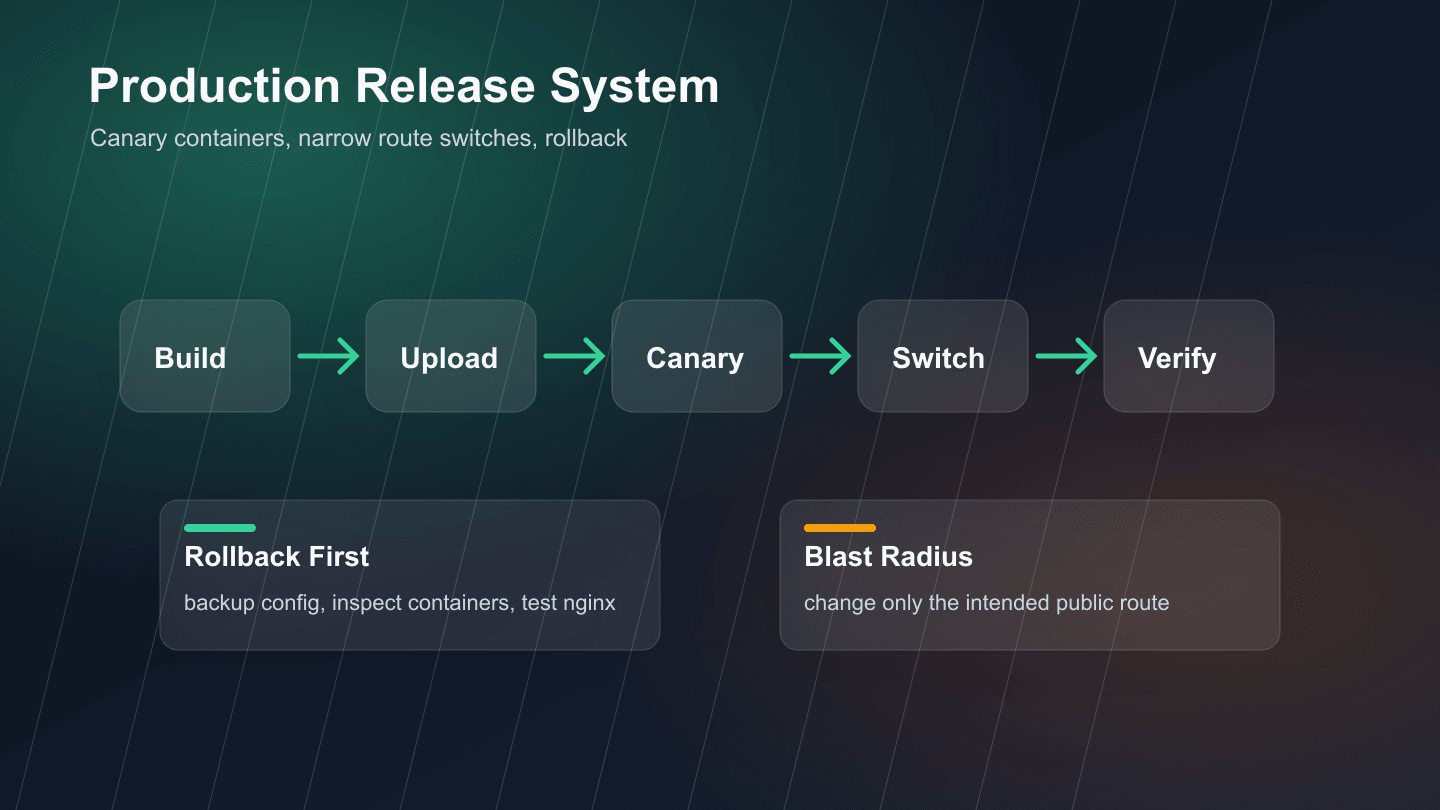
A deployment workflow for shipping web services with canary containers, narrow Nginx route switches, direct health checks, and concrete rollback scripts.
Production Release System
Small production systems still need disciplined release paths. The goal is not process for its own sake; the goal is to make deployment boring, observable, and reversible. This work describes a release system pattern for web apps behind Docker and Nginx.
  • Build the candidate locally or in CI before traffic changes.
  • Start the new service beside the existing one on an internal port.
  • Verify the canary directly before touching the public route.
  • Change only the intended Nginx location.
  • Keep a rollback script and previous config before reload.
  • Verify unrelated services after the switch.
The release flow uses standalone application artifacts, timestamped release directories, a versioned container name, and a route-level Nginx update. That keeps the live service and the candidate service separate until the public switch. It also makes rollback concrete: restore the old route, test Nginx, reload, and verify.
  • Prefer additive deployment over replacing a running service in place.
  • Treat production routing as drift-prone and verify it live.
  • Avoid touching databases or unrelated subdomains for frontend-only releases.
  • Record the rollback path before the route is changed.
Good deployment work is quiet. It reduces surprise, limits blast radius, and makes the next release easier to trust.

Related work

AI Workflow Console

AI Workflow Console

A product pattern for supervising multi-step AI workflows with context, tool calls, human review, observability, and rollback points.
Full-Stack Product Foundation

Full-Stack Product Foundation

A reusable application foundation for product interfaces, typed APIs, authentication boundaries, data flows, and deployment-ready configuration.